A competition proposal for the United Kingdom’s pavilion at Dubai Expo 2020. The project takes Britain’s contribution to satellite science and engineering as the origin for its form, visitor route and environmental system.
/
Reference
01
British scientific work helped define a satellite-enabled future.
The proposal draws a line from Newton’s work on orbital mechanics, through Arthur C. Clarke’s prediction of the geostationary satellite, to Alan Turing’s contribution to computation and the UK’s contemporary small-satellite industry. Three research strands generated three forms: the toroidal path of orbit, the ramp of ascent and Simon Guest’s Wrapping Fold Pattern for deployable space structures.


/
System
02
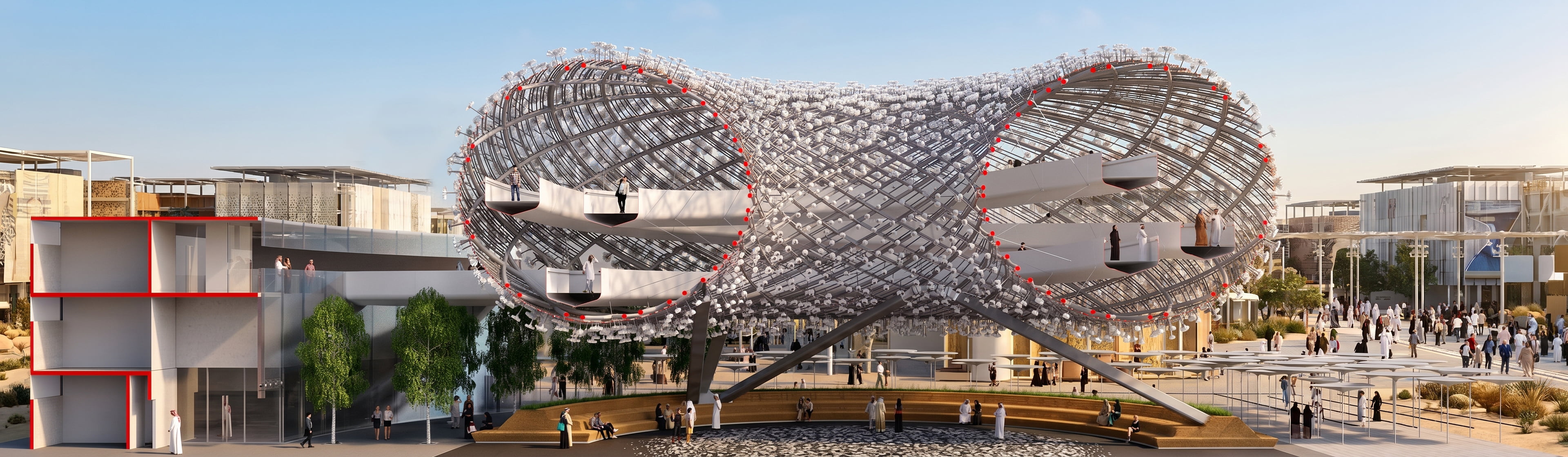
The torus, ramp and umbrellas form one system.
The primary structure is a torus made from constant-radius steel tubes, using repeated details for efficient fabrication and demounting. A spiral ramp is suspended inside it, following the logic of a satellite ascending toward stable orbit. The surface is covered with 6,000 individually motorised umbrella units derived from the Wrapping Fold Pattern. Each unit provides shade, carries LED light and responds to visitor data. The umbrellas also adjust to sun and wind, supporting passive cooling and natural ventilation.


/
Resolution
03
Science becomes structure, route and atmosphere.
Visitors move through the pavilion in three acts: history, immersion and live data. Outside, the torus reads as a dense field of white deployable units. At night, those units become a responsive light surface. The structure is designed to be demounted and reassembled after the Expo, extending the satellite logic from theme to construction. A satellite does not stay where it is launched. Neither does this building.


Latest Projects.
A curated selection of projects that reflect our commitment to simplicity and purposeful design.
The work
The work