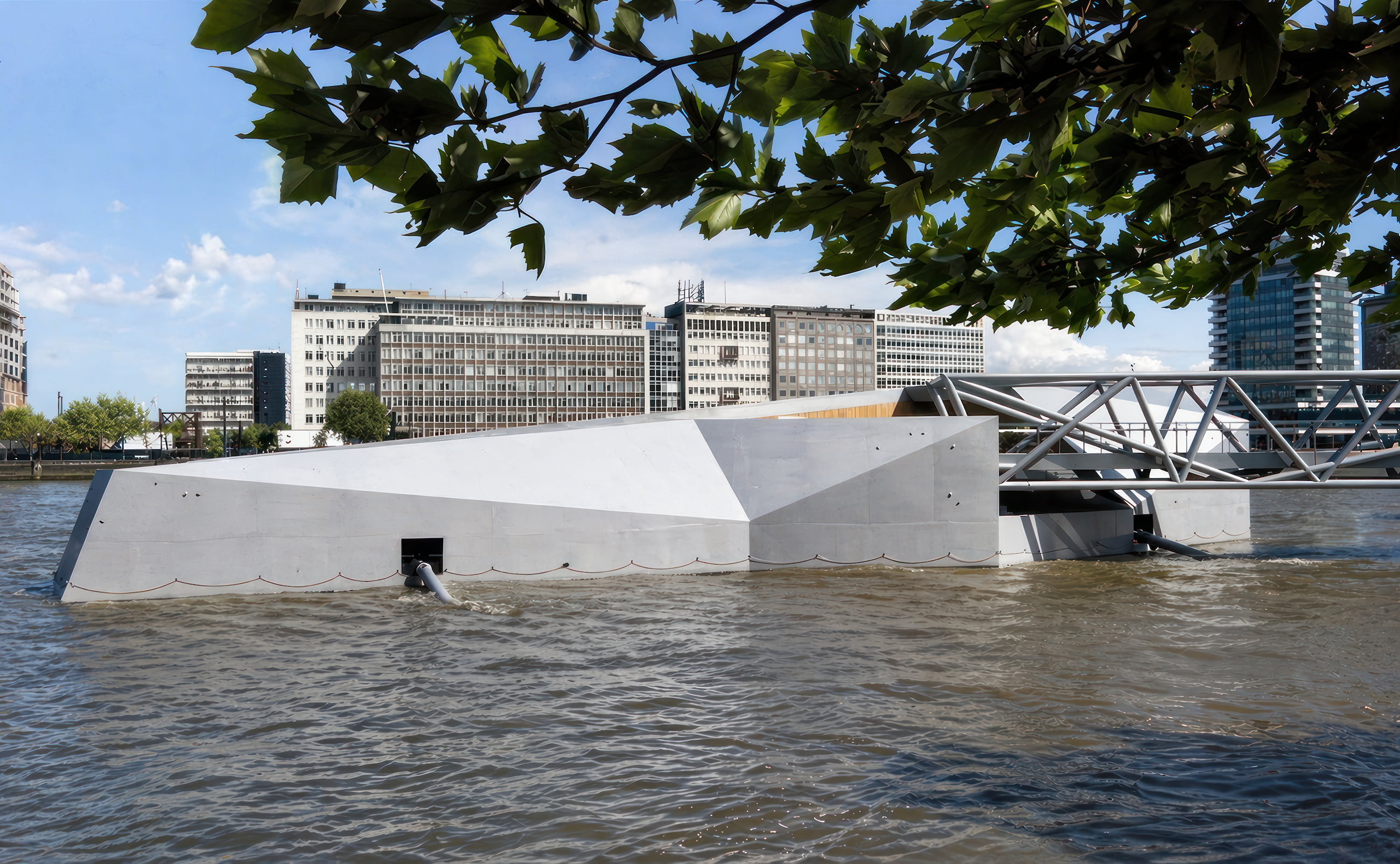
A river pier on the Thames in front of Tate Britain. Steel outside and timber within are developed as two opposing material conditions held by the same geometric logic.
/
Reference
01
Three references define the pier: Tate Britain, Naum Gabo and the river security landscape.
The pier sits directly in front of Tate Britain, where Naum Gabo’s Constructed Head No. 2 forms a key reference. Gabo constructed form from flat metal plates, without added mass or modelling. The second reference is the US Navy Sea Shadow, whose faceted geometry deflects radar through large angled planes. Between MI5 and MI6, that language had direct site relevance. Together, the references pointed toward flat plate steel, folded and welded into a working river structure.


/
System
02
One material outside. One material inside.
The exterior is formed from welded plate steel, allowing the pontoon, ramps and accommodation to read as one continuous object. Radial arms hold the pier in position, reducing the need for conventional piles. The shore connection is an irregular Warren truss of circular steel tubes. Inside, the logic reverses. Walls, ceiling, seating and ramp lining are formed as one continuous faceted surface in larch timber. The pier also incorporates Angela Bulloch’s permanent lighting work, Flash and Tidal, which responds to the movement of the Thames.


/
Resolution
03
A working pier formed through material opposition.
From the river, the pier reads as a low angular steel form. From inside, it becomes a warm timber volume. The transition is direct: hard outside, warm within, both shaped by the same faceted discipline. The project applies Gabo’s flat-plate logic at the scale of public river infrastructure.
Project designed and delivered by Steven Chilton as project architect at Marks Barfield Architects.
Photos: Nick Wood



Latest Projects.
A curated selection of projects that reflect our commitment to simplicity and purposeful design.
The work
The work