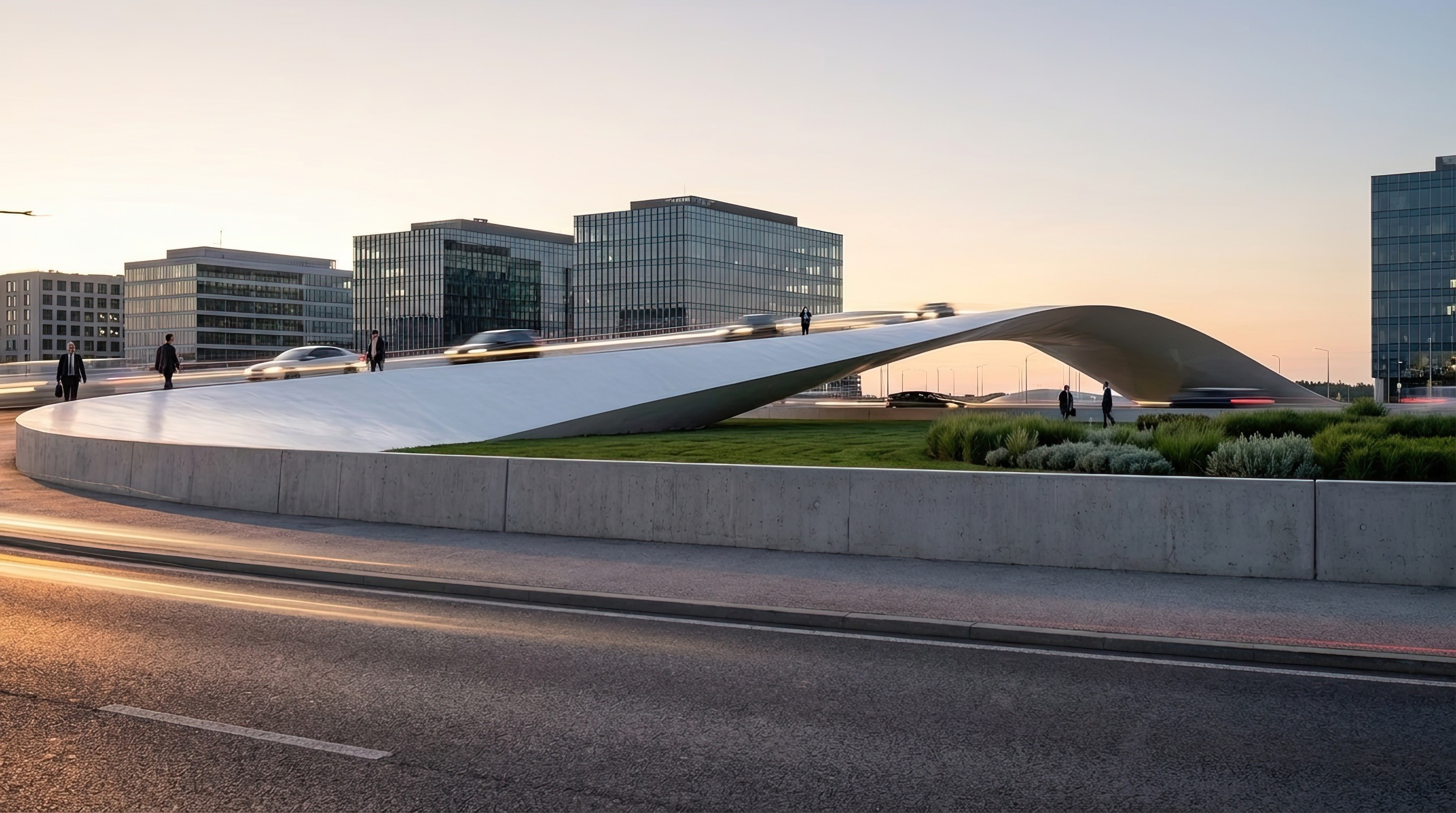
A pedestrian bridge over the A127, conceived as one continuous white surface. Road banking, footpath ramps, edge and span are treated as a single structural ribbon rising from the ground and returning to it.
/
Reference
01
The bridge takes its cue from the structure of a leaf.
A leaf is a thin surface made strong by curvature, edge condition and internal stiffening. The project applies that principle to infrastructure. The crossing is not treated as a deck with supports and parapets added to it. It begins in the landscape, rises into span, then returns to the ground through the same material logic.



/
System
02
The surface becomes structure, route and landscape.
The bridge is conceived as a monocoque body: a continuous skin fixed to an underlying frame. Plate steel forms the road edge, pedestrian route, ramp, banking and span without changing language. Curvature and depth give the surface its strength. Off-site fabrication using yacht-building technology allows the large curved body to be formed and finished under controlled conditions before installation.


/
Resolution
03
A crossing resolved as one material act.
The proposal removes the usual separation between bridge, ramp, parapet and landscape. Each part changes role as it moves through the site, but the system remains continuous. The result is light, strong and highly finished, with movement, structure and fabrication developed together.
Project designed by Steven Chilton as project director at Marks Barfield Architects.


Latest Projects.
A curated selection of projects that reflect our commitment to simplicity and purposeful design.
The work
The work